Should I Absorb GST or Add It to My Prices When I Register for GST?
Updated September 2026
Registering for GST does not mean you have to increase every existing customer price by exactly 10%. You can pass the GST on, keep your current GST-inclusive price and absorb the effect, or increase the price by less than 10%. GST must still be accounted for correctly on taxable sales, and consumer-facing prices must comply with Australian price-display rules.
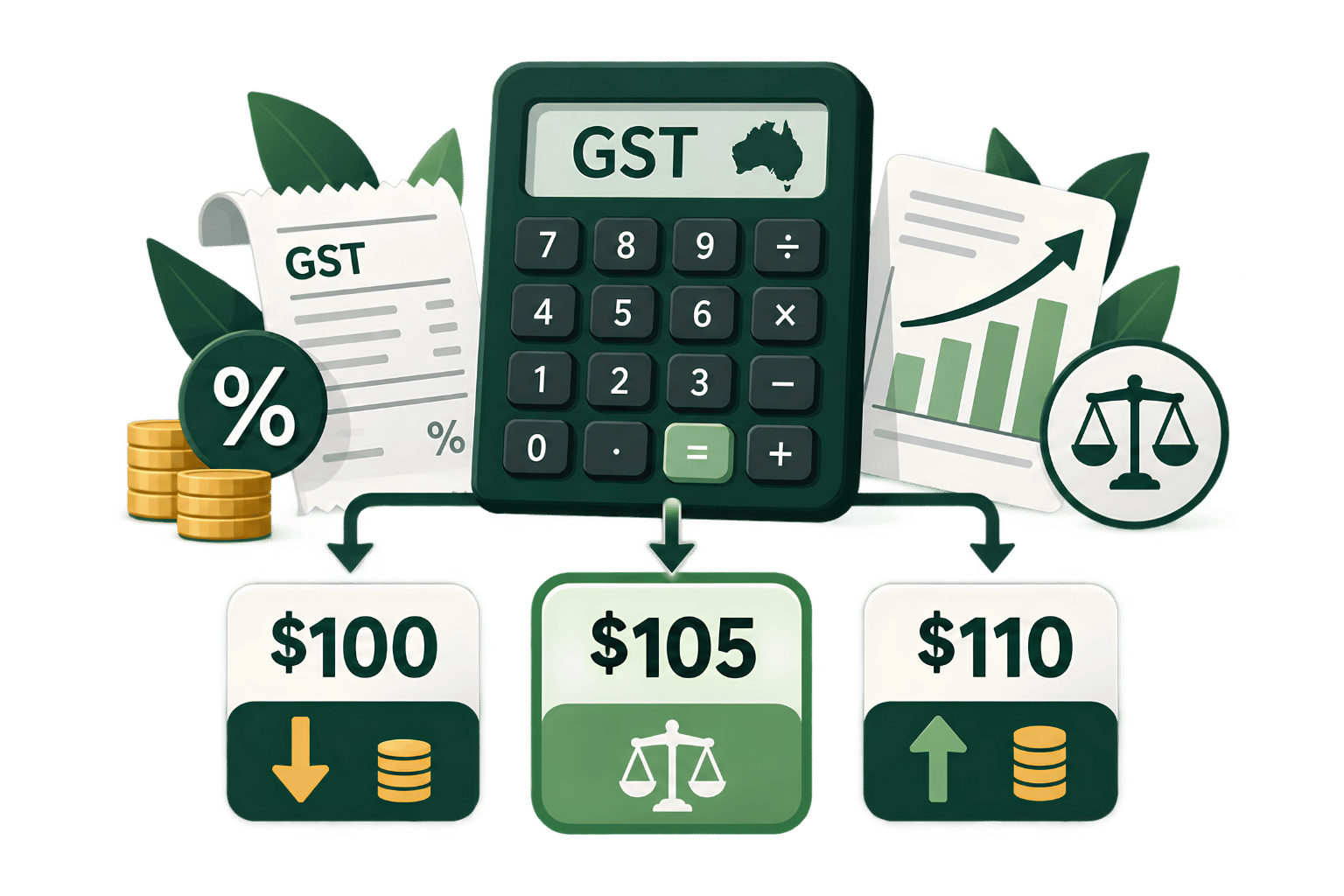
If a $100 price becomes $110, you retain $100 of revenue excluding GST. If you continue charging $100, only $90.91 is revenue excluding GST. A compromise price such as $105 leaves you with $95.45 before costs.
Which approach makes sense depends on your customers, costs, available GST credits and how sensitive customers are to price changes.
On this page
Useful calculators
On this page
What actually changes when you register for GST?
GST is a 10% tax on most goods, services and other items sold or consumed in Australia. A GST-registered business generally includes GST in the price of taxable sales and may claim GST credits for GST included in eligible business purchases.
That creates two different questions:
They are not the same number.
Suppose you currently charge $100 for a service before registering for GST.
| Pricing approach | Customer pays | GST included | Revenue excluding GST |
|---|---|---|---|
| Pass on all GST | $110.00 | $10.00 | $100.00 |
| Absorb all GST | $100.00 | $9.09 | $90.91 |
| Split the difference | $105.00 | $9.55 | $95.45 |
For an ordinary taxable sale, the GST contained in a GST-inclusive price is generally 1/11th of the total price.
If you don't want to calculate this manually, you can use our GST Calculator to add GST to a price or separate GST from a GST-inclusive amount.
Why absorbing GST reduces the revenue you keep
If your existing selling price is $100 and you decide not to increase it after registering:
You can also calculate the ex-GST amount as:
Your customer still pays $100, but the full $100 is no longer business revenue excluding GST.
This does not necessarily mean your overall GST liability increases by $9.09 for every $100 sale. GST credits on eligible business purchases can reduce the net GST payable through your Business Activity Statement.
That distinction becomes important when deciding whether absorbing GST is commercially sustainable.
Pass on GST, absorb it or split the difference
Assume you currently charge $100, have $60 of costs, cannot claim GST credits on those particular costs and make $40 gross profit.
Before GST registration: $40 ÷ $100 = 40% gross margin.
| Item | Before registration | Pass on GST | Absorb GST | Increase to $105 |
|---|---|---|---|---|
| Customer price | $100.00 | $110.00 | $100.00 | $105.00 |
| GST included | — | $10.00 | $9.09 | $9.55 |
| Revenue ex GST | $100.00 | $100.00 | $90.91 | $95.45 |
| Cost | $60.00 | $60.00 | $60.00 | $60.00 |
| Gross profit | $40.00 | $40.00 | $30.91 | $35.45 |
| Gross margin | 40.0% | 40.0% | 34.0% | 37.1% |
Pass on all GST: $100 becomes $110
The customer pays $110. The $10 GST component leaves $100 of revenue excluding GST. Assuming your costs have not changed, your $40 gross profit is preserved.
Absorb all GST: keep charging $100
The customer still pays $100. However, $9.09 of that amount is GST, leaving $90.91 of revenue before costs. With $60 of costs, gross profit falls from $40 to $30.91. The customer sees no price increase, but the business gives up $9.09 of gross profit on each $100 sale in this simplified example.
Split the difference: increase the price to $105
The customer pays $105 rather than $110. The GST component is approximately $9.55, leaving $95.45 of revenue excluding GST. Gross profit becomes approximately $35.45. You have not preserved the full previous profit per sale, but you have also avoided putting the full 10% increase in front of the customer.
GST registration therefore does not necessarily create an all-or-nothing pricing decision.
Use the Margin Calculator and Markup Calculator to compare the two measures.
Don't overlook GST credits on your business expenses
Looking only at GST on your sales can overstate the financial impact of registration.
A GST-registered business may claim GST credits for eligible business purchases where the ATO's requirements are satisfied. Broadly, the purchase must be for business use, include GST and meet the relevant creditability and record-keeping requirements.
Not every expense produces a GST credit.
For example, the ATO states that you cannot claim GST credits for wages or for purchases where there is no GST in the price. Purchases from suppliers that are not registered or required to be registered for GST also generally do not contain GST for you to claim.
A product business with GST-bearing costs
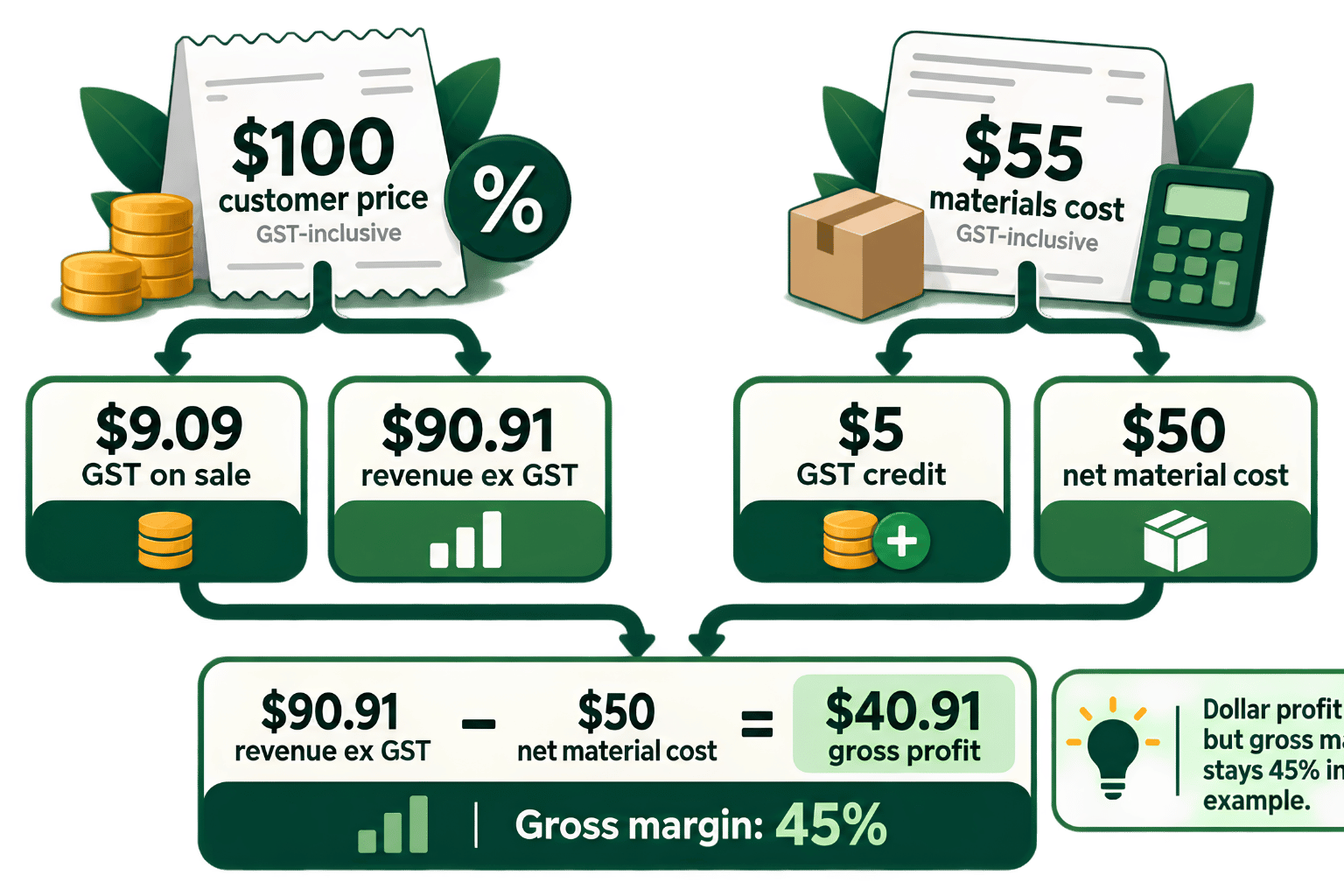
Suppose you sell a product for $100 and currently pay $55 GST-inclusive for materials.
| Before GST registration | Amount |
|---|---|
| Selling price | $100 |
| Materials | $55 |
| Gross profit | $45 |
| Gross margin | 45% |
| After registration, absorbing GST | Amount |
|---|---|
| Customer price | $100 |
| GST included in sale | $9.09 |
| Revenue excluding GST | $90.91 |
| Net material cost | $50 |
| Gross profit | $40.91 |
| Gross margin | 45% |
After registration, assume the entire $55 purchase qualifies for a GST credit. $55 ÷ 11 = $5 GST. In this simplified example, your material cost after the $5 GST credit is effectively $50 for the gross-profit calculation.
Should I add GST if most of my customers are businesses?
For businesses selling mainly to GST-registered customers that can claim GST credits on their purchases, passing GST through may be less commercially significant than it is in a consumer market.
If a GST-registered customer makes a creditable acquisition from you and meets the ATO's requirements, it may be able to claim the GST included in your invoice as a GST credit.
| Example | Amount |
|---|---|
| Service previously cost | $1,000 |
| After registering | $1,100 including GST |
| GST component | $100 |
| Potential effective ex-GST cost | $1,000 |
A qualifying GST-registered business customer may be able to claim that $100 as a GST credit, leaving an effective ex-GST cost of $1,000, subject to its circumstances.
Do not assume every business customer can recover all the GST. Whether the customer is registered and whether its purchase qualifies for a GST credit both matter.
For price-display purposes, the ACCC states that where prices are displayed only to other businesses, GST does not have to be included in the displayed total price.
What if most of my customers are consumers?
The commercial calculation is different when you mainly sell to households or other end consumers.
Ordinary retail consumers generally cannot claim GST credits on private purchases. Increasing a price from $100 to $110 therefore represents a genuine $10 increase in what the customer pays.
- Will customers accept the new price?
- How does your new price compare with competing businesses?
- How much gross profit can you afford to give up?
- How much GST can you recover on eligible business costs?
A residential cleaner, hairdresser, photographer or tradesperson may therefore reach a different pricing decision from a consultant selling predominantly to GST-registered businesses.
You might pass the full increase through on some services while increasing others by less than 10%. You might also review packages, minimum charges or service tiers instead of mechanically adding 10% to every existing price.
The important step is to calculate the effect on profit before changing your prices.
Can I advertise "$100 + GST" to consumers?
For consumer-facing prices, generally not as a substitute for displaying the total amount payable.
The ACCC says businesses must display a total price that includes taxes, duties and unavoidable or pre-selected fees. If part of the price is also displayed separately, the total price must be at least as prominent.
| Example | Amount |
|---|---|
| Total price | $110 including GST |
| Price before GST | $100 |
| GST | $10 |
You could separately show that the amount consists of $100 plus $10 GST, provided the $110 total price is displayed appropriately.
The ACCC applies a different rule where prices are displayed only to other businesses: GST does not have to be included in the displayed total price.
Your price-display obligations are therefore separate from your pricing strategy.
Choosing commercially to pass GST on does not mean advertising a lower consumer price and adding GST only when the customer reaches checkout or receives the invoice.
When do I have to register for GST?
For most businesses, the GST registration turnover threshold is $75,000. The threshold is $150,000 for non-profit organisations, and special rules apply to some activities such as taxi and ride-sourcing services.
GST turnover is based on business turnover, not profit. The ATO also excludes certain amounts when calculating GST turnover, including GST included in your sales.
The ATO considers both:
- current GST turnover — generally the current month plus the previous 11 months
- projected GST turnover — generally the current month plus the following 11 months
Importantly, having current GST turnover at or above $75,000 does not always mean registration is required if projected GST turnover will be below the threshold. Conversely, projected GST turnover reaching the threshold can require registration even where current turnover is still below it.
Once you become required to register, you generally have 21 days to do so.
If you fail to register when required, GST consequences can apply from the date you should have been registered, even if GST was not included in the prices charged to customers.
If you believe you should have registered earlier, obtain advice appropriate to your circumstances. See the ATO's GST registration guidance.
How should I decide whether to absorb GST or increase my prices?
Calculate your existing profit per sale
Start with your current selling price and actual costs.
Do not confuse markup with margin. If maintaining a particular gross margin matters, calculate it using the revenue you retain excluding GST rather than the GST-inclusive amount paid by the customer.
Test several GST-inclusive selling prices
At minimum, compare your current price, your current price plus 10%, and one or two prices between those amounts.
If your current price is $100, testing $100, $105 and $110 immediately shows how much revenue you retain under each approach.
Recalculate your costs after eligible GST credits
Identify which business purchases contain GST that you are actually entitled to claim.
Do not automatically divide every expense by 1.10. GST credits depend on the nature of the purchase and the ATO's eligibility requirements.
Compare gross profit and gross margin
A pricing option that looks harmless from the customer's perspective may have a substantial effect on your profit.
Likewise, a business with significant creditable GST-bearing inputs may experience less of a financial impact than a labour-heavy business with relatively few GST credits.
Consider who your customers are
A GST-registered business customer that can claim a GST credit experiences your price change differently from a household paying the full GST-inclusive price.
If you serve both markets, one blanket pricing assumption may not suit every product or service.
Check existing contracts and accepted quotes
If you already have fixed-price contracts, accepted quotations or other agreements in place, check how they deal with GST before assuming you can simply add 10% to an agreed amount.
The outcome can depend on the wording and circumstances of the agreement, so obtain professional advice where necessary.
What about hourly-rate businesses?
GST registration can have a particularly noticeable effect on labour-heavy businesses because wages do not include GST and therefore do not generate GST credits.
Suppose your existing customer price is $100 per hour.
| Measure | Amount |
|---|---|
| Customer price | $100 |
| GST included | $9.09 |
| Revenue excluding GST | $90.91 |
| Reduction in ex-GST revenue | Approximately $9.09 per billable hour |
| Across 1,000 billable hours | Approximately $9,091 |
These figures are before taking account of eligible GST credits on other business expenses.
For consultants, contractors and tradespeople, GST registration can therefore be a sensible time to review the underlying charge-out rate rather than treating GST purely as an invoicing change. Use the Hourly Rate Calculator to test the underlying rate.
Can I absorb GST temporarily?
You can choose to keep the same GST-inclusive customer price, but the decision should be based on whether the resulting profit remains sustainable.
If absorbing some or all of the GST reduces profit per sale, calculate how much additional sales volume would be required to produce the same overall gross profit with the Break-Even Calculator.
FAQs
Does absorbing GST mean the sale becomes GST-free?
No. If you are registered for GST and the sale is taxable, keeping the customer's final price unchanged does not make the sale GST-free. It means the GST is contained within the price you have chosen to charge.
If I increase my price from $100 to $105, am I only charging 5% GST?
No. GST is still calculated under the normal GST rules. A $105 GST-inclusive taxable price contains approximately $9.55 GST. You have simply chosen to increase your former $100 customer price by 5% rather than increasing it to $110.
Can I claim GST credits if I absorb GST?
Potentially, yes. Your ability to claim a GST credit depends on the purchase and the GST rules, not on whether you increased your customer prices. For purchases costing more than $82.50 including GST, you generally need a valid tax invoice to claim the credit.
There is no single pricing choice that suits every business
The useful comparison is:
A business with mainly GST-registered commercial customers may approach the decision differently from a consumer-facing service business. A product business with substantial creditable GST-bearing inputs may also experience a different financial effect from a labour-heavy operator with few recoverable GST costs.
Registering for GST is therefore a good reason to review your actual pricing economics, rather than automatically adding 10% to every price or absorbing the GST without calculating its effect.
Sources & References
Related Guides
General information only. GST treatment, registration requirements, contractual rights and pricing obligations can depend on individual circumstances. Consider obtaining advice from a registered Australian tax or BAS agent, accountant or legal adviser where appropriate.