Margin vs Markup: What's the Difference?
Updated October 2026
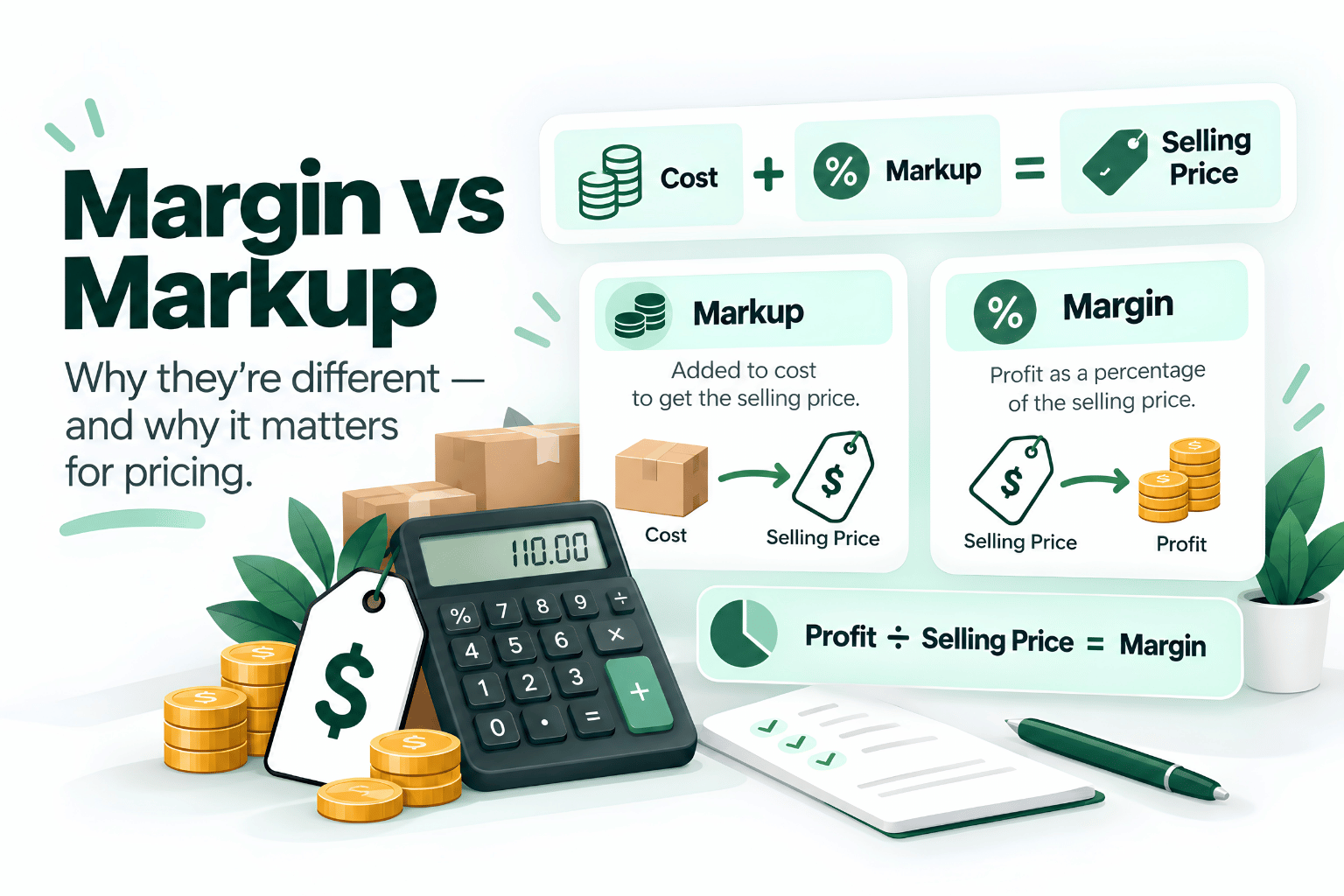
Margin and markup both describe profit, but they measure it from different starting points.
Markup is the percentage you add to your cost to arrive at a selling price. Margin is the percentage of the selling price that remains as gross profit after the direct cost is deducted.
That means a 50% markup does not give you a 50% margin.
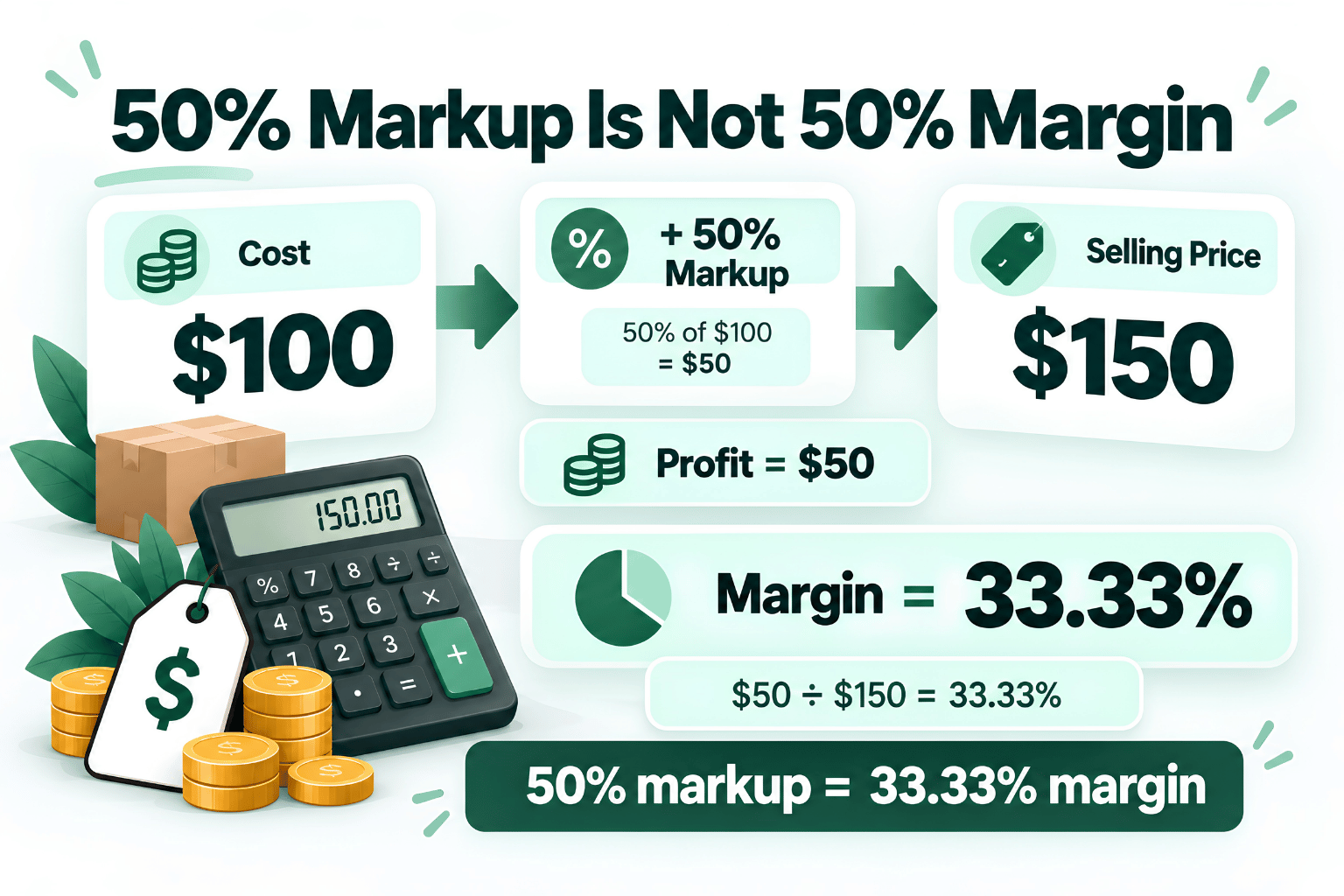
If something costs $100 and you add a 50% markup, you sell it for $150. Your profit is $50, but your margin is only 33.33%.
A common pricing mistake is taking a target margin percentage and simply adding the same percentage to cost. That can leave your selling price lower than intended.
On this page
Useful calculators
On this page
Margin vs markup at a glance
| Metric | Markup | Margin |
|---|---|---|
| Based on | Cost | Selling price |
| Main purpose | Building a selling price | Measuring profitability |
| Formula | Profit ÷ Cost × 100 | Profit ÷ Selling price × 100 |
| $100 cost, $150 sale | 50% | 33.33% |
Both percentages describe the same $50 gross profit. They differ because that profit is being compared with a different number.
What is markup?
Markup measures how much you add to a cost when setting a selling price.
If you already know the markup you want:
Example: adding a 40% markup
Suppose a product costs your business $200 excluding GST.
A 40% markup adds:
The selling price is therefore:
Your gross profit is $80.
The markup is 40% because the $80 profit represents 40% of the original $200 cost.
Markup is useful when you are building a selling price from a known cost, such as when pricing inventory, preparing a quote or marking up materials.
If you don't want to calculate this manually, you can use the BizCalc Markup Calculator.
What is margin?
Margin looks at the same transaction from the selling-price side.
It asks: What percentage of the selling price is gross profit?
Using the previous example:
- Cost: $200
- Selling price: $280
- Gross profit: $80
So a 40% markup produces a 28.57% margin.
If you're checking the gross margin produced by a selling price, you can use the BizCalc Margin Calculator.
Why is a 50% markup not a 50% margin?
Suppose something costs you $100.
If you apply a 50% markup:
The selling price becomes:
Your gross profit is $50.
Markup calculation: $50 ÷ $100 = 50%
Margin calculation: $50 ÷ $150 = 33.33%
Markup compares profit with the cost. Margin compares the same profit with the selling price. For a normal profitable sale where the selling price is higher than the cost, the markup percentage will therefore be higher than the corresponding margin percentage.
How do you achieve a 50% margin?
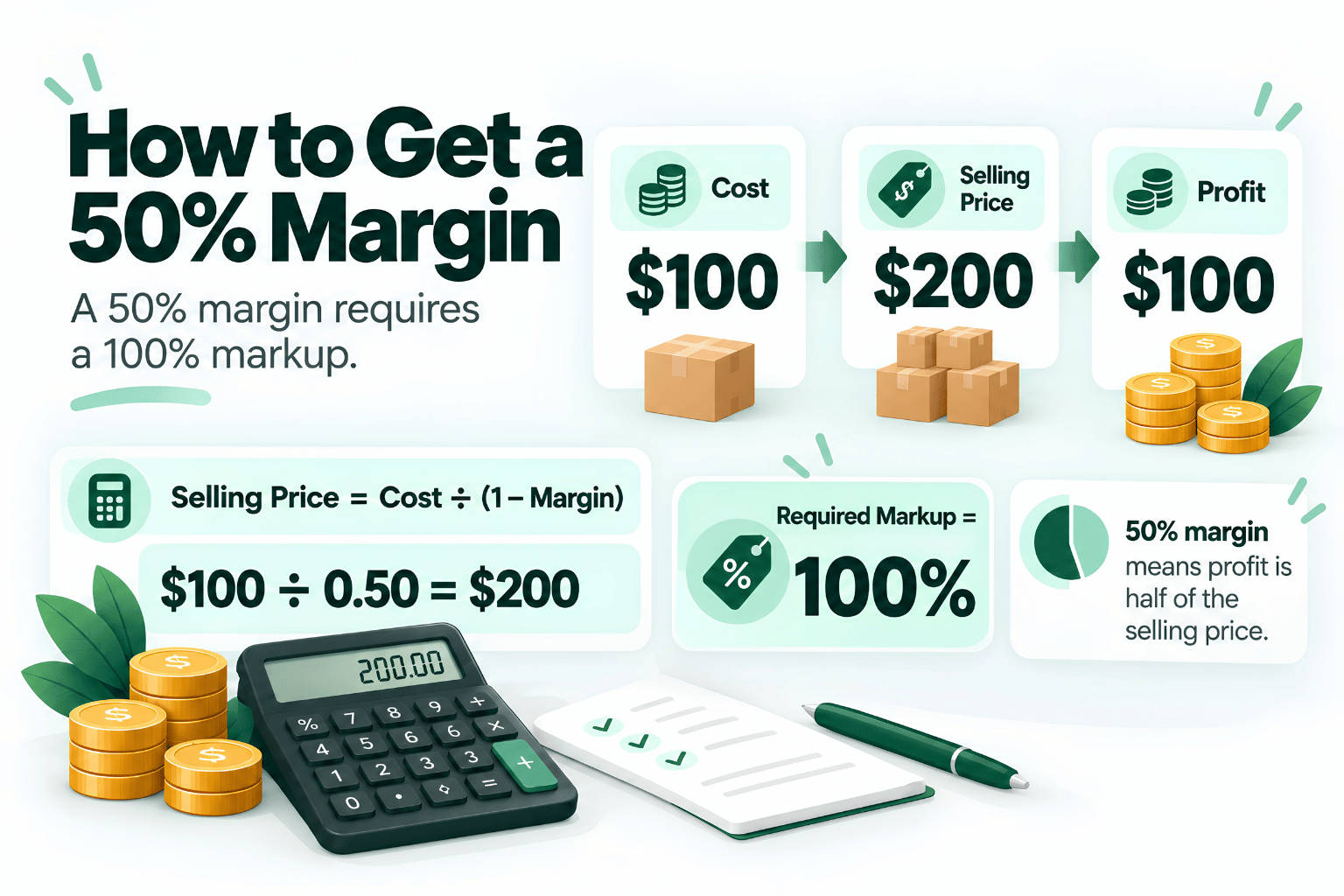
If your product costs $100 and you actually want a 50% gross margin, simply adding 50% will not work.
For a 50% margin:
Check the result:
- Selling price: $200
- Cost: $100
- Gross profit: $100
- Margin: $100 ÷ $200 = 50%
To achieve a 50% margin on a $100 cost, you therefore need a 100% markup.
| $100 cost | Selling price | Profit | Markup | Margin |
|---|---|---|---|---|
| 50% markup | $150 | $50 | 50% | 33.33% |
| 50% margin | $200 | $100 | 100% | 50% |
Why confusing margin and markup can lead to underpricing
The difference becomes more important when the same pricing error is repeated across multiple jobs or sales.
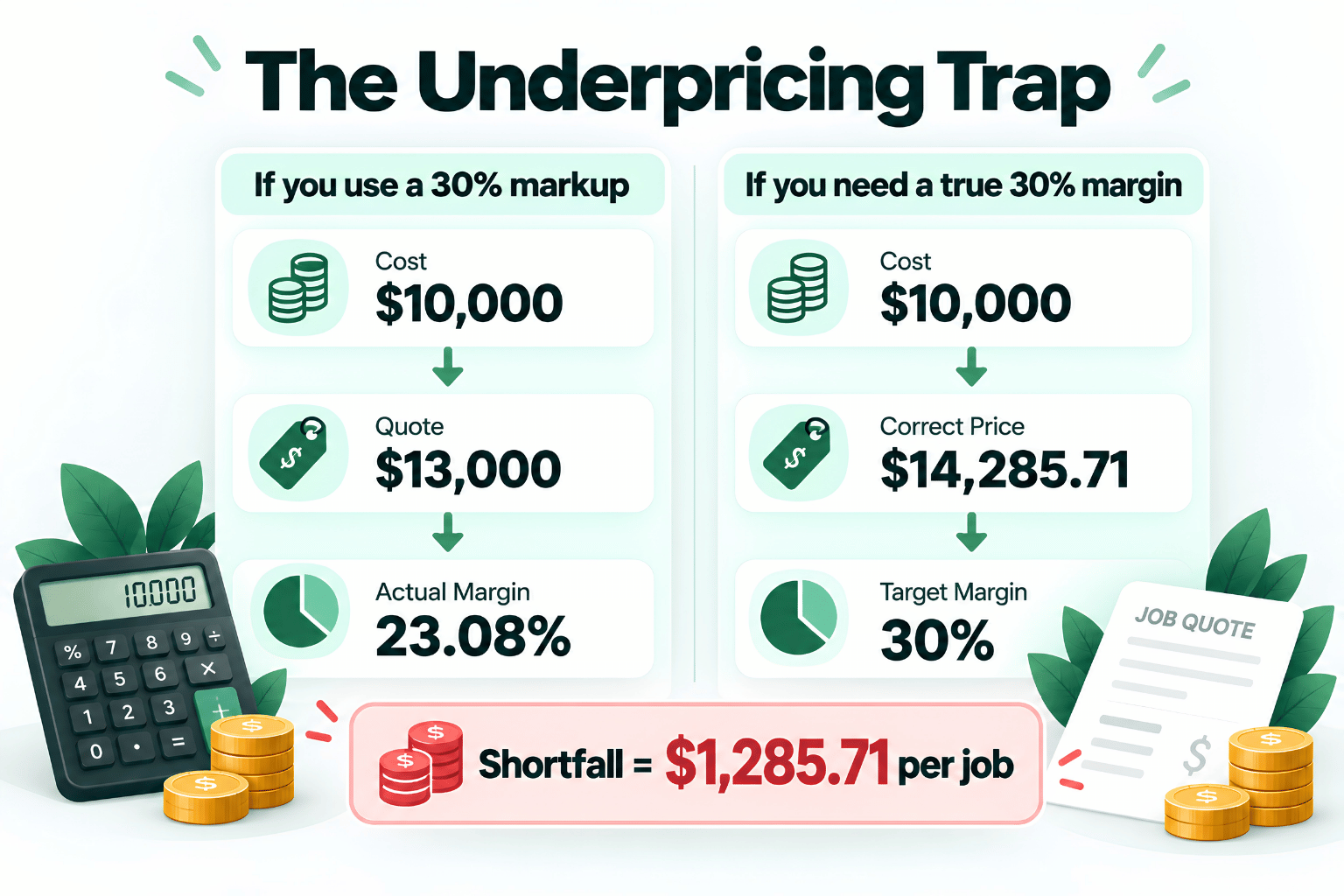
Suppose the direct cost of a job is $10,000 and you want a 30% gross margin.
If you mistakenly apply a 30% markup:
Your gross profit is:
But your actual margin is:
You wanted a 30% margin but achieved only 23.08%.
What should the price have been?
The pricing difference is approximately:
Using the exact calculation before rounding, repeating that error across 40 identical jobs produces a cumulative pricing shortfall of approximately $51,428.57.
That does not mean every business should target a 30% margin. Appropriate margins vary by industry, business model and cost structure. The example simply shows what happens when a target margin is mistakenly used as a markup.
How do you convert markup to margin?
Use percentage as a decimal.
Example: 50% markup = 0.50; 0.50 ÷ 1.50 = 0.3333; therefore 50% markup = 33.33% margin.
| Markup | Equivalent margin |
|---|---|
| 25% | 20.00% |
| 33.33% | 25.00% |
| 42.86% | 30.00% |
| 50% | 33.33% |
| 66.67% | 40.00% |
| 100% | 50.00% |
How do you convert margin to markup?
Example: desired margin 40% = 0.40.
So a 40% margin requires approximately a 66.67% markup.
If cost is $300:
Check:
- Selling price: $500
- Cost: $300
- Gross profit: $200
- Margin: $200 ÷ $500 = 40%
When should you use markup and when should you use margin?
Both are useful, but they serve different purposes.
Use markup when building a price from cost
Markup is useful when your starting point is a known cost, such as pricing purchased stock, marking up materials, preparing cost-plus quotes or applying pricing multipliers to inventory or job costs.
Use margin when checking profitability
Margin is useful when you want to understand how much of the selling price remains as gross profit. It can help when reviewing product profitability, comparing jobs, analysing gross profit and checking whether selling prices are producing the intended result.
What about GST when calculating margin and markup?
For ordinary taxable sales, it is important to use figures consistently when comparing costs and selling prices.
For GST-registered businesses that are entitled to claim the relevant GST credits, using GST-exclusive cost and GST-exclusive selling price will usually give a clearer view of the underlying commercial margin.
Example
Suppose your GST-exclusive cost is $200 and you want a 40% margin.
GST at 10% is approximately $33.33, so the GST-inclusive selling price is approximately $366.66.
The commercial margin calculation is based on:
- GST-exclusive selling price: $333.33
- GST-exclusive cost: $200
- Gross profit: $133.33
- Gross margin: 40%
Use the BizCalc GST Calculator to move between GST-exclusive and GST-inclusive figures.
For consumer-facing pricing, Australian price-display rules generally require businesses to show the minimum total price as a single figure, including taxes and unavoidable charges. Different circumstances can apply to business-to-business pricing and to GST-free or input-taxed supplies, so the GST treatment of a particular transaction should be checked where necessary.
Margin is not the same as net profit
In product and job-pricing discussions, margin usually refers to gross profit margin.
Gross margin shows what remains after the relevant direct costs have been deducted. It does not mean that the same percentage becomes net profit.
The business may still need to cover operating expenses such as administration, insurance, software, premises and other overheads.
That is why a business can have a healthy gross margin but a much lower net profit margin.
Is there a good margin every business should target?
No single margin is appropriate for every business.
Suitable margins vary according to industry, business model, direct costs, overheads, sales volume and pricing strategy.
The ATO publishes small-business benchmarks for selected industries that can help businesses compare certain cost and expense ratios with similar businesses, but these should not be treated as prescribed profit-margin targets.
FAQs
Is a 50% markup the same as a 50% margin?
What markup gives a 30% margin?
What margin does a 25% markup produce?
Can markup be more than 100%?
The simple way to remember margin vs markup
The difference comes down to what you compare the profit with:
- Markup compares profit with cost.
- Margin compares profit with the selling price.
If you're building a selling price from your costs, use the BizCalc Markup Calculator. If you're checking how much of the selling price remains as gross profit, use the BizCalc Margin Calculator.
Understanding the distinction helps prevent a target margin from accidentally being applied as a markup and producing a lower selling price than intended.
Sources & References
Related Calculators
Related Guides
General information only. Pricing, GST and business performance can depend on individual circumstances. Consider obtaining advice from a registered Australian tax or BAS agent, accountant or legal adviser where appropriate.