How to Price a Product or Service in Australia
Updated September 2026
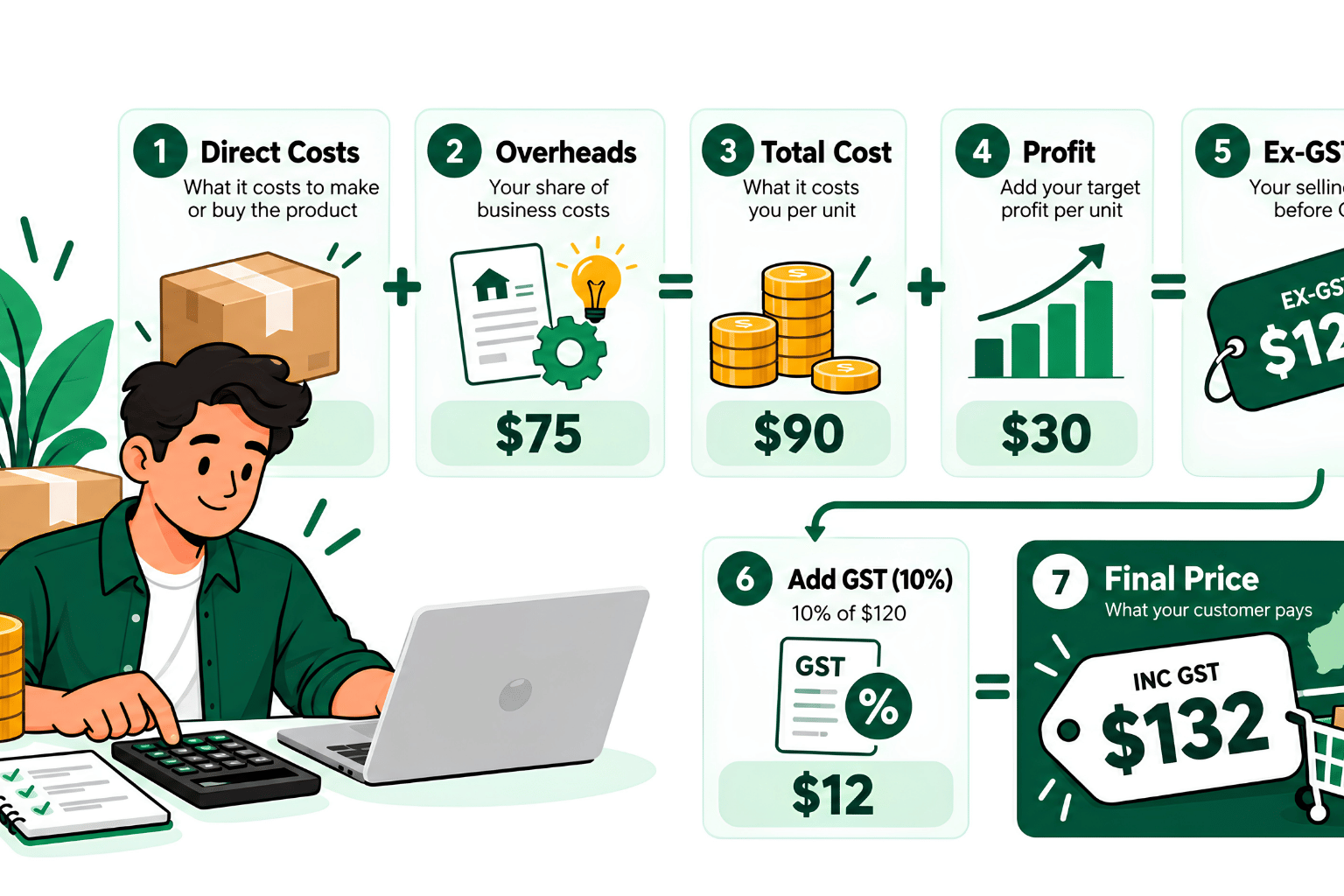
To price a product or service in Australia, work out what one sale really costs you, including a fair share of overheads and a wage for yourself. Divide that cost by one minus the profit margin you want, to get your price before GST. If you're registered for GST, add 10%. Then check the result against your break-even point. If you sell time, your "cost" is your income target plus expenses, divided by the hours you can realistically bill. That is well below the hours you work.
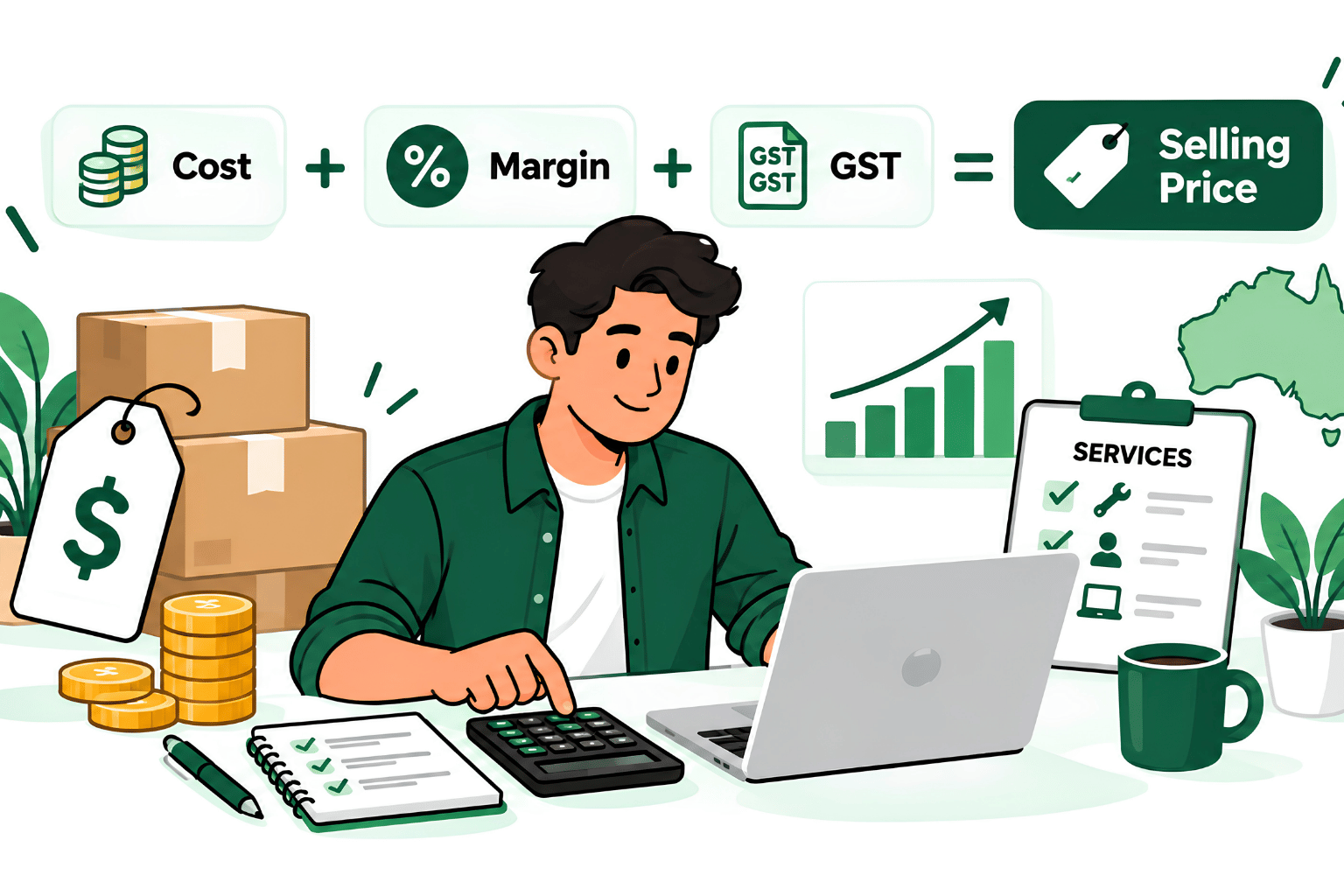
Costs that are a percentage of the price, such as card fees, go into the divisor too. If you're registered and GST applies to the sale, add the 10%. Then check that the price clears break-even and holds up in your market. The examples below use made-up businesses. Swap in your own figures.
On this page
Useful calculators
On this page
What does one sale really cost you?
Costs fall into two buckets, plus a wage for you.
Variable costs: what you spend each time you sell
Materials or stock, freight, packaging, card fees, and the wages of anyone who makes or delivers the product. If those people are employees, add super on top of their wages.
The super guarantee rate is 12%. Since 1 July 2026 (Payday Super) employers pay it with each payday instead of quarterly. Paid leave, workers' compensation insurance and other on-costs vary with your situation, so ask your accountant what belongs in your labour cost.
If you use subcontractors, check whether they count as employees for super. The ATO's qualifying earnings guidance refers to employees "including eligible contractors".
Fixed costs: what you pay whether or not you sell
Rent, insurance, software, vehicles, your accountant, equipment wear and tear. To put these into a unit price, divide monthly overheads by the units you expect to sell in a month.
Use a cautious volume. If overheads are $12,000 a month and you budget 400 units, each unit carries $30. If you only sell 250, the real figure is $48, and a price built on $30 is too low.
Your own wage
Sole traders and partners often leave themselves out, because drawings don't appear as a wage expense. Put in a market wage, meaning what you'd pay someone else to do your job. Profit is what's left above that.
Sole traders and partners don't have to pay super for themselves, but they can choose to. If you want retirement savings in line with an employee's, treat that as a cost.
How do you work out an hourly rate?
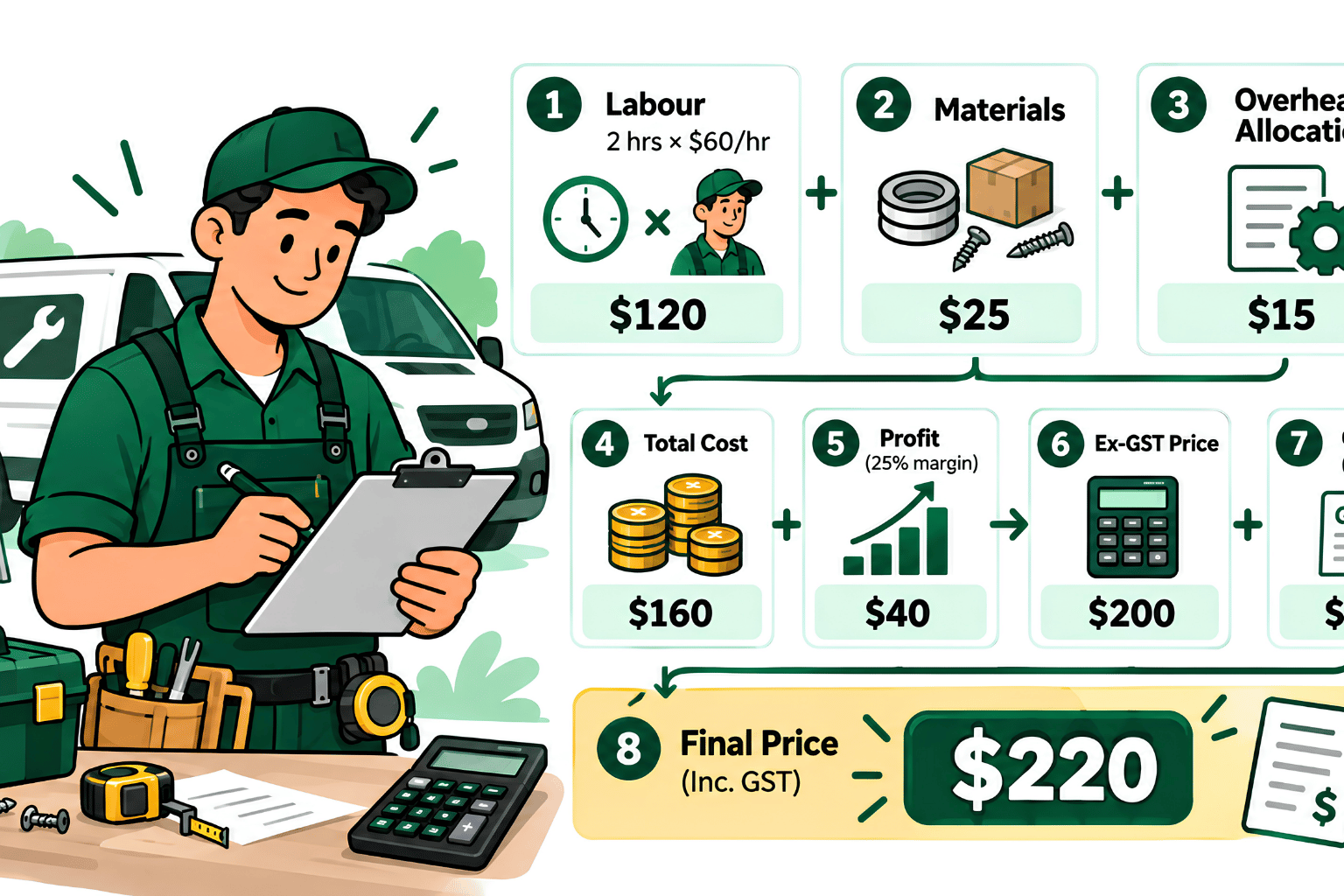
If you sell your time, the maths is the same, but you divide by billable hours, not hours worked. Leave, public holidays, sick days, quoting, travel between jobs, admin and chasing payments all eat into the year.
A Brisbane sole-trader electrician
An electrician works out an hourly rate for residential jobs.
Money the business needs to earn in a year:
| Item | Amount |
|---|---|
| Income target before income tax | $115,000 |
| Own super, by choice (12% of $115,000) | $13,800 |
| Business expenses (vehicle lease, fuel, insurance, licences, tools, software, accountant) | $31,400 |
| Total | $160,200 |
Hours available:
| Item | Hours |
|---|---|
| 52 weeks × 40 hours | 2,080 |
| Less 4 weeks' leave | 160 |
| Less 11 public holidays | 88 |
| Less sick days and training | 80 |
| Available hours | 1,752 |
| Billable hours at a 65% billable share (an assumption) | 1,138.8 |
The rate:
The 65% is illustrative. Yours is a number you can measure. Track a few months of timesheets and count what you can't invoice. Materials are charged separately, with their own margin (see the next two sections).
If you don't want to calculate this manually, you can use our hourly rate calculator. To reproduce the example, enter a target income of $128,800 (income plus super), overheads of $31,400, a 20% margin, and about 26 billable hours a week over 43.8 weeks. That returns $175.84 ex GST. Rounding to 44 weeks gives $175.04.
Markup vs margin: the mistake that quietly costs you money
- Markup is profit as a percentage of cost.
- Margin is profit as a percentage of the price.
A product costs $60 and you add a 40% markup. The price is $84, the profit is $24, and the margin is 28.6%, not 40%. To get a true 40% margin, divide the cost by 0.60, which gives $100.
This is the markup you need for a target margin:
| Target margin | Markup needed |
|---|---|
| 20% | 25% |
| 30% | 42.9% |
| 40% | 66.7% |
| 50% | 100% |
| 60% | 150% |
Pick one measure and stick to it. Margin is the better one to work in, because it shows how much of each sales dollar stays in the business. To check either number, use our margin calculator or markup calculator.
How do you turn cost into a price?
The margin in the formula is profit after all costs, including overheads, before income tax. That is stricter than the margin left after direct costs alone, which can look healthy while the business still loses money.
A tool belt made in regional Victoria and sold online
The owner wants a 30% profit margin, and every sale is paid by card at 1.85%. That rate is an example, so use your provider's.
| Cost per unit | Amount |
|---|---|
| Materials | $26.50 |
| Assembly labour (0.6 hours × $34.00) | $20.40 |
| Super on that labour (12%) | $2.45 |
| Packaging and printed manual | $3.15 |
| Shipping and fulfilment | $9.40 |
| Overhead share ($12,000 ÷ 400 units) | $30.00 |
| Cost before card fees | $91.90 |
Card fees are typically charged on the total the customer pays, GST included. So 1.85% of the total is about 2.035% of the ex-GST price. A cost that is a percentage of the price goes into the divisor, because it grows as the price grows:
Add GST: $135.22 × 1.10 = $148.74, which you might round to $149.
Check: the card fee is 1.85% × $148.74 = $2.75. Profit is $135.22 − $91.90 − $2.75 = $40.57, which is 30% of $135.22.
Our selling price calculator does the divide-by-margin step for you. It takes extra costs in dollars, not as a percentage. Enter $91.90 as the unit cost, your estimated card fee ($2.75) as the additional cost per sale, and 30% as the margin. You'll get about $135.21, within a cent of the figure above. Because the $91.90 already includes overheads, the calculator's "gross profit" figure is your profit after overheads.
Card fees are part of your price
From 1 October 2026, the eftpos, Mastercard, Visa and American Express networks are applying "no surcharge" rules, so you can't add a surcharge to those card payments. Card costs then have to sit inside your prices, as in the example above. Other payment types may work differently, so check with your payment provider. The card networks and payment providers enforce these rules, not the ACCC.
Check the price against break-even
Break-even is the number of sales at which you cover fixed costs and no more. First find the contribution per unit, meaning what each sale contributes toward overheads and profit after variable costs:
At the budgeted 400 units, the business makes $16,228 a month before income tax. If you can't see yourself reaching break-even volume, price isn't the only lever. Costs, volume and the offer are the others. To test your own figures, use our break-even calculator.
A cost-based price is a floor
The formula gives the lowest price that meets your profit target at the volume you assumed. Customers may pay more, in which case charge more. They may pay less, in which case the problem is your costs, volume or offer.
Price against the value of the result where you can, and look at competitors' prices without copying them. Their costs and volumes aren't yours. This guide can't tell you what your market will pay. Testing will.
GST: which price do you show?
Do you have to charge GST?
You must register for GST if your GST turnover is $75,000 or more ($150,000 for non-profits), and you have 21 days to register once you know you've reached it. business.gov.au explains that GST turnover is your business income, not your profit. Taxi and ride-sourcing drivers must register regardless of turnover. Below the threshold, registration is optional.
This changes the numbers you start with:
- Registered: you can generally claim GST credits for GST in the price of business purchases, so work with costs excluding GST. See our guide on profit margin before or after GST.
- Not registered: you don't add GST to your prices, and the GST on your purchases is a cost you can't recover.
Not every sale carries GST. The ATO lists GST-free sales such as most basic food and some education and health services. Check your situation with your accountant or BAS agent. If you've just registered and are deciding whether to lift prices, see our guide to absorbing GST or adding it to your prices.
Consumers or businesses?
The ACCC says a business must display a total price that includes GST and any unavoidable or pre-selected fees, as a single figure. If you also show a part price, the total must be at least as prominent. If you display prices only to other businesses, you don't need to include GST in the total.
In practice, the electrician quotes a homeowner $193.42 an hour. To a builder, the same work can be quoted as $175.84 plus GST. If your prices are public on a website, consumers can see them, so showing GST-inclusive prices is the safe approach.
Converting between the two
- Ex GST to inc GST: × 1.10
- Inc GST to ex GST: ÷ 1.10
- GST inside an inc-GST price: ÷ 11 ($148.74 ÷ 11 = $13.52)
Our GST calculator does the conversion, and we have guides on adding GST to an amount and removing GST from a total.
What a discount does to your profit
A discount comes straight off the margin, so a small one can take a large share of your profit per sale. The extra volume you need to earn the same dollar profit is:
Here "margin" is the contribution margin: the share of the price left after variable costs only. If you don't know yours, our contribution margin calculator works it out.
A Sydney gym selling corporate memberships
The gym charges $120 a month ex GST, has a variable cost of $36 per member and $21,000 of fixed costs a month, and has 300 members.
| Item | Amount |
|---|---|
| Price ex GST | $120 |
| Variable cost per member | $36 |
| Contribution per member (70% margin) | $84 |
| Monthly profit: (300 × $84) − $21,000 | $4,200 |
Now discount by 20%. The price falls to $96 and the contribution to $60.
To keep the same profit, the gym needs 420 members, because 420 × $60 = $25,200 contribution, so profit is still $4,200.
How fast the volume requirement grows
This table shows how quickly the requirement grows when margins are thin:
| Starting margin | 5% off | 10% off | 15% off | 20% off |
|---|---|---|---|---|
| 20% | +33.3% | +100% | +300% | No volume is enough |
| 30% | +20% | +50% | +100% | +200% |
| 40% | +14.3% | +33.3% | +60% | +100% |
| 50% | +11.1% | +25% | +42.9% | +66.7% |
| 60% | +9.1% | +20% | +33.3% | +50% |
Two caveats. The maths assumes fixed costs don't rise with volume and that everyone gets the discount, including existing customers. If more members mean more staff or floor space, you need more than the table shows. A discount for new customers only works out differently.
Our discount calculator shows the margin impact of a discount. Enter prices excluding GST.
If you advertise the discount
- "Was/now" prices. The ACCC says the earlier price should have been charged for a reasonable period right before the sale, and what counts as reasonable depends on the case. Calling a long-running price a "sale" price can also mislead. The ACCC can investigate misleading price displays and take enforcement action.
- Payment-method discounts (for cash or PayID, say). Show the full price, and don't make the discounted price more prominent.
FAQs
What profit margin should I aim for?
There's no universal number. Overheads, your wage and your volume decide what you need. Work backwards: add your wage, your overheads and the profit you want, then see what price and volume that requires. If the answer isn't credible in your market, the fix is in costs, volume or the offer.
How do I price a fixed-price quote?
Use the same maths. Estimate hours × your hourly rate, add materials with their margin, and add an allowance for overrun. Quote consumers a GST-inclusive total.
How often should I review my prices?
Business Victoria suggests about every three months. Review sooner when a major cost changes, such as super payment timing (Payday Super from 1 July 2026) or how you can pass on card fees (from 1 October 2026).
Get your numbers checked
Several inputs depend on your situation: employment costs, award pay rates, whether some of your sales are GST-free, and whether contractors count as employees for super. Ask a registered accountant, BAS agent or lawyer to check your cost figures before you finalise prices. Our calculators do the sums. They don't replace professional advice.
Sources & References
Australian Taxation Office — About Payday Super
Australian Taxation Office — What payments are qualifying earnings
Australian Taxation Office — Super for sole traders and partnerships
Australian Taxation Office — Registering for GST
Australian Taxation Office — GST bookkeeping and credits
Australian Taxation Office — GST-free sales
business.gov.au — Register for GST
Australian Competition and Consumer Commission — Price displays
Related Guides
General information only. Pricing, GST, super and consumer law obligations can depend on individual circumstances. Consider obtaining advice from a registered Australian tax or BAS agent, accountant or legal adviser where appropriate.