Do I Calculate Profit Margin Before or After GST?
Updated September 2026
Before GST. If you're registered for GST, work out your profit margin on GST-exclusive figures: what you sold for without the GST you collected, and what you paid without the GST you'll claim back. If you're not registered, there's no GST in your sales at all, but the GST on your purchases becomes a real cost. That case has its own section below.
Check your margin using consistent sales and cost figures.
On this page
Useful calculators
On this page
Someone hands you $110 for a job. Ten dollars of that was never yours.
"Ex-GST" means the GST is left out. "Inc-GST" means it's in the number. Every figure below is labelled one way or the other, because mixing them up is the whole problem.
"Profit margin" gets used loosely. Gross margin only counts the direct cost of what you sell, like stock, materials and subcontractors. Net margin also takes off overheads. The GST logic is the same for both, and the examples here are gross margin.
Why GST stays out of your margin
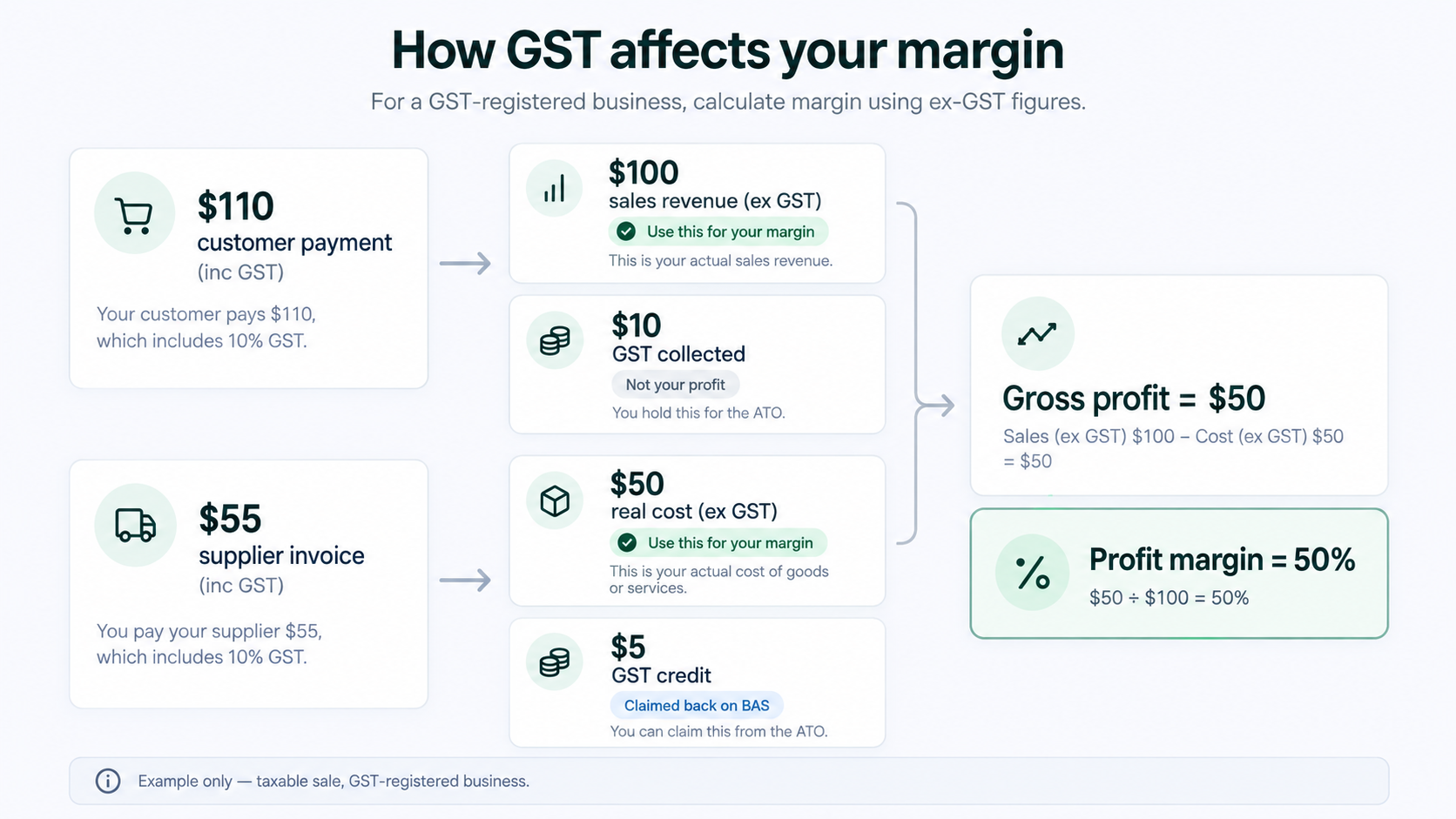
GST is a pass-through tax. If you're registered, you collect it from customers on the ATO's behalf. You can generally claim GST credits for the GST in business purchases that relate to taxable or GST-free sales. On your business activity statement (BAS), you pay the difference or get a refund.
So for a registered business making taxable sales, the GST it collects and the GST it can recover are neither income nor expense. They're money passing through, which is why margin is worked out ex-GST on both sides.
There's one catch. Any GST you can't claim back is a real cost, and it stays in your cost figure. That comes up below.
Exclude GST collected where applicable
Exclude claimable GST
Keep it as part of cost
What goes wrong when GST sneaks in
The classic mistake is mixing the two. The customer pays a GST-inclusive price, the supplier's price list is ex-GST, and someone divides one by the other.
You're registered. You sell a product for $110 inc-GST. The supplier's invoice was $55, which is $50 plus $5 GST that you claim back.
| Item | Mixed up (GST left in the sale) | Correct (ex-GST) |
|---|---|---|
| Customer pays | $110.00 | $110.00 |
| GST inside that $110 | ignored | $10.00 |
| Your sales revenue | $110.00 | $100.00 |
| Cost (ex-GST) | $50.00 | $50.00 |
| Gross profit | $60.00 | $50.00 |
| Gross margin | 54.5% | 50.0% |
The $5 credit on your purchase reduces what you pay, and the rest goes to the ATO. Plan your rent and wages around 54.5% and BAS time will find the gap.
Put GST on both sides and the percentage survives: $110 against a $55 cost is still 50%. But the dollar profit reads $55 when it's really $50. The percentage also breaks as soon as something carries no GST, like wages or a GST-free item.
Taking GST out of a GST-inclusive price
So $165 inc-GST is $150 ex-GST, with $15 of GST. If you don't want to calculate this manually, use the GST calculator.
From cost to price tag
Knowing your margin is half the job. The other half is setting a price that delivers it.
You're registered. The supplier invoice for one unit is $132: $120 plus $12 GST that you claim back. Your cost is $120 ex-GST. You want a 40% margin.
Divide, don't multiply
$120 ÷ (1 − 0.40) = $120 ÷ 0.60 = $200 ex-GST
Watch the markup trap
Adding 40% gives $168. The $48 profit is 28.6% of $168, not 40%. Use the markup calculator to compare.
Add GST last
If the sale is taxable, $200 × 1.1 = $220 inc-GST, of which $20 is GST.
| Measure | Amount |
|---|---|
| Supplier invoice | $132 inc-GST |
| GST credit | $12 |
| Cost used | $120 ex-GST |
| Target margin | 40% |
| Calculated selling price | $200 ex-GST |
| Customer price | $220 inc-GST |
Pricing a service? Use the same sequence with direct costs as the cost. The selling price calculator can run the steps for you.
Which numbers should I use?
It depends on whether you're registered and what you're selling.
| Situation | Use for sales | Use for costs |
|---|---|---|
| GST-registered, taxable sale | Price minus GST (ex-GST) | Ex-GST, to the extent you can claim the GST back |
| GST-registered, GST-free sale | Price as charged (no GST in it) | Ex-GST, where GST credits are available |
| GST-registered, input-taxed sale (such as residential rent or financial supplies) | Price as charged | Include any GST you can't claim |
| Not registered for GST | Price as charged | Full amount you paid, GST included |
The GST-free row works because a registered business can still claim credits on purchases related to GST-free sales. The input-taxed row works because you can't claim credits on the purchases behind input-taxed sales. If your sales are a mix of these, the credit rules get fiddly, and that's one for your accountant.
If you compare your margin with the ATO's small business benchmarks, use ex-GST figures, because the ATO measures turnover excluding GST. Its key benchmark also leaves labour out of cost of sales, so it won't match your gross margin exactly.
If you're not registered for GST
You generally need to register when your GST turnover reaches the $75,000 threshold. The ATO looks at both current GST turnover (this month plus the previous 11 months) and projected GST turnover (this month plus the next 11 months). Even if your current turnover is at or above $75,000, you may not need to register if your projected turnover will be below the threshold. Once you're required to register, you generally have 21 days. Taxi, limousine and ride-sourcing drivers must register whatever their turnover, and so must anyone who wants to claim fuel tax credits. Below the threshold, registering is optional. The ATO's registration page explains how the tests work together.
If you're not registered, you don't add GST to your prices and you can't claim GST credits. So the GST your suppliers charge is a genuine cost.
Same job, registered vs not registered
The supplier invoice is $88 ($80 plus $8 GST). The customer pays $150 either way.
| Item | GST-registered | Not registered |
|---|---|---|
| Supplier invoice | $88.00 | $88.00 |
| GST credit you can claim | $8.00 | $0.00 |
| Your real cost | $80.00 | $88.00 |
| Customer pays | $150.00 | $150.00 |
| GST inside that $150 | $13.64 | none |
| Your sales revenue | $136.36 | $150.00 |
| Gross profit | $56.36 | $62.00 |
| Gross margin | 41.3% | 41.3% |
| Net GST paid to the ATO | $5.64 | $0.00 |
None of this makes staying unregistered better or worse than registering voluntarily. That depends on your costs, your customers and your plans, so it's one to ask your accountant.
The percentages match because the sale and the cost are both taxable at 10%. The dollars differ. On these transactions, the registered business has net GST of $5.64, which happens to equal 10% of its $56.36 gross profit.
The real danger is the unregistered operator who copies the $80 from the supplier's ex-GST column. That gives a margin of 46.7% ($70 ÷ $150). The true figure is 41.3%. If you're unregistered, use the full $88 you paid.
What price do customers see?
Set your price ex-GST, then add GST if the sale is taxable. The ACCC says prices displayed to consumers must be the total, including GST, as a single figure. Prices displayed only to other businesses don't need to include GST, so a business quote can say "$200 + GST".
If you don't want to calculate your margin manually, use the profit margin calculator. Once you know it, the break-even calculator shows how much you need to sell to cover rent, wages and everything else.
FAQs
Is GST included in gross profit?
Not for a registered business making taxable sales. Gross profit is ex-GST sales minus ex-GST cost of sales, so recoverable GST stays out on both sides.
Is this the same as the property margin scheme?
No. The ATO's margin scheme is a separate rule for some property sales, where GST is worked out on one eleventh of the margin instead of the full price. It has nothing to do with the profit margin on the products or services you sell.
Sources & References
Related Calculators
Profit Margin Calculator
Calculate profit margin from selling price and costs.
GST Calculator
Add, remove or isolate Australian GST.
Markup Calculator
Calculate a selling price using markup on cost.
Selling Price Calculator
Work backwards from cost and a target margin.
Break-Even Calculator
Find the sales needed to cover business costs.
Related Guides
General information only. This is general information, not tax, accounting or legal advice, and it can't account for your circumstances. Registration, mixed sales and how you report can all change the answer, so check with your accountant, bookkeeper or the ATO.