How to Add GST to an Amount in Australia
Updated September 2026
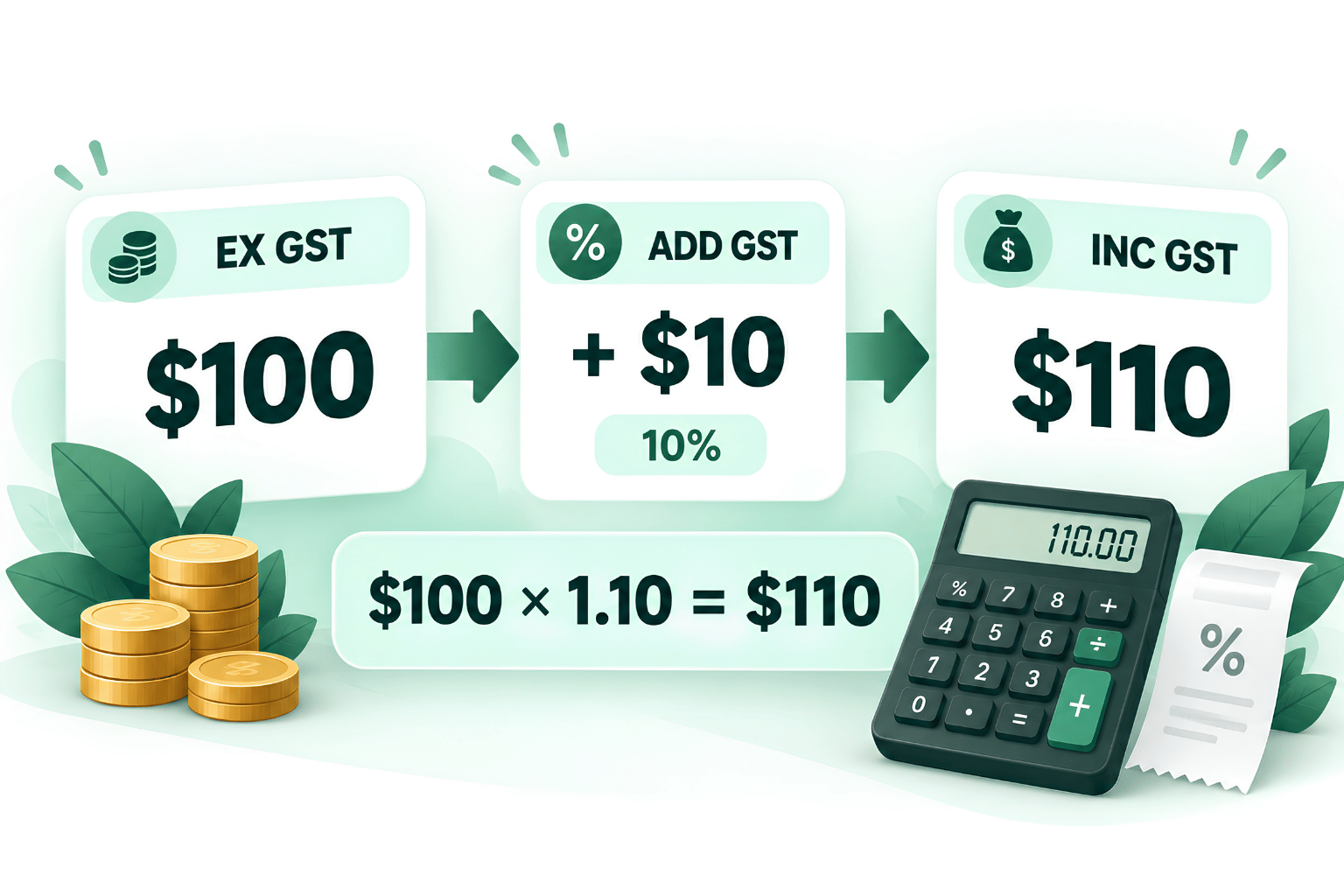
To add GST to an amount in Australia, multiply the GST-exclusive amount by 1.10.
For example, if your price is $100 excluding GST:
$100 × 1.10 = $110 including GST
The GST component is $10.
You can also calculate the GST separately by multiplying the GST-exclusive amount by 0.10, then adding it to the original price.
Important: this calculation assumes the starting amount is excluding GST and the sale is subject to GST. If the amount already includes GST, multiplying it by 1.10 would add GST twice.
On this page
Useful calculators
On this page
GST calculation at a glance
| Calculation | Formula |
|---|---|
| GST amount from an ex-GST price | Amount × 0.10 |
| Total price including GST | Amount × 1.10 |
| GST contained in an inc-GST price | Amount ÷ 11 |
| Price before GST from an inc-GST price | Amount ÷ 1.10 |
For a standard taxable sale, the first two formulas are the ones you need when adding GST.
You can also use the BizCalc GST Calculator to calculate the GST component and total price.
How do you add 10% GST to an amount?
There are two ways to do it.
Method 1: Calculate the GST and add it
Take the GST-exclusive price and multiply it by 10%.
For a $250 price:
Then add the GST to the original price:
Method 2: Multiply by 1.10
You can reach the same answer in one calculation:
Multiplying by 1.10 works because the final amount consists of the original 100% price plus 10% GST.
Adding GST to a service quote
Suppose a tradesperson is preparing a quote and the labour and materials total $820 excluding GST.
Calculate the GST:
Then calculate the total:
| Item | Amount |
|---|---|
| Price excluding GST | $820.00 |
| GST | $82.00 |
| Total including GST | $902.00 |
Or calculate directly:
$820 = excluding GST
$902 = including GST
How to add GST in Excel or Google Sheets
If the GST-exclusive amount is in cell A2, calculate the total including GST with:
To calculate just the GST:
If A2 contains 820:
GST: $82.00
Total including GST: $902.00
These formulas are useful for straightforward individual amounts. More complex invoices with multiple taxable line items can involve specific GST rounding rules.
Can you add GST to every amount?
No.
The × 1.10 formula assumes that the amount is GST-exclusive and relates to a taxable sale.
Not every sale is taxable. Some supplies are GST-free or input taxed, and the GST treatment depends on what is being supplied and the circumstances of the transaction.
A sale is generally taxable if you are registered or required to be registered for GST, the sale is for payment, is made in the course of operating your business, is connected with Australia, and is not GST-free or input taxed.
So you should not automatically multiply every invoice subtotal by 1.10.
What if an invoice contains taxable and GST-free items?
GST should only be applied to the taxable portion.
Example:
- $600 taxable sales
- $200 GST-free sales
GST on taxable sales:
Invoice total:
Applying 10% to the entire $800 would produce the wrong GST amount.
If you are unsure whether a particular product or service is taxable, GST-free or input taxed, check the relevant ATO guidance or seek advice appropriate to your circumstances.
Do you have to be registered for GST before adding GST?
GST registration and the mathematical calculation are separate issues.
For most Australian businesses and enterprises, the GST registration threshold is $75,000 of GST turnover.
The ATO assesses both:
- current GST turnover — generally the current month plus the previous 11 months
- projected GST turnover — generally the current month plus the next 11 months
There are important qualifications to those tests. For example, the ATO states that a business whose current GST turnover is at or above the threshold may not have to register if its projected GST turnover is below the threshold.
Once a business is required to register, it generally has 21 days to do so. Different rules apply in certain situations. Taxi, limousine and ride-sourcing operators, for example, must generally register regardless of their GST turnover.
See the ATO's GST registration guidance.
If you should already have registered but haven't, the situation is different. The ATO says you may still have to pay GST on sales from the date you were required to register, even if you did not include GST in the prices you charged.
If that applies to you, the correct treatment will depend on your circumstances.
Should customer prices include GST?
If you sell directly to consumers, how you display the price matters as well as how you calculate it.
The ACCC says businesses must display the minimum total price as a single figure, including taxes such as GST and unavoidable or pre-selected fees. If a partial price is also displayed, the total price must be at least as prominent.
| Price display | Example |
|---|---|
| Does not show the full consumer price | $100 + GST |
| Clearer total price | $110 including GST |
| Optional breakdown | $100 price + $10 GST |
See the ACCC's price display guidance.
The ACCC makes an important distinction for business-to-business pricing: where prices are displayed only to other businesses, GST does not have to be included in the displayed total price.
That distinction is particularly relevant to trades and service businesses that deal with both commercial customers and consumers.
What if the GST calculation produces fractions of a cent?
Some GST calculations produce fractions of a cent.
For a tax invoice containing one taxable sale, the ATO says the GST amount should be rounded to the nearest cent, with half a cent rounded upwards.
Where an invoice contains more than one taxable sale, the ATO provides two methods known as the total invoice rule and the taxable supply rule.
This is one reason a manual calculation and accounting software can occasionally produce a small rounding difference on a multi-line invoice.
For a straightforward single taxable sale, calculate the GST and round the resulting GST amount to the nearest cent in accordance with the ATO's rounding rules.
Adding GST when setting your selling price
Adding GST and deciding what your underlying selling price should be are two different calculations.
Example underlying selling price:
$400 excluding GST
GST-inclusive:
Use the Margin Calculator to check how your costs and underlying selling price affect margin.
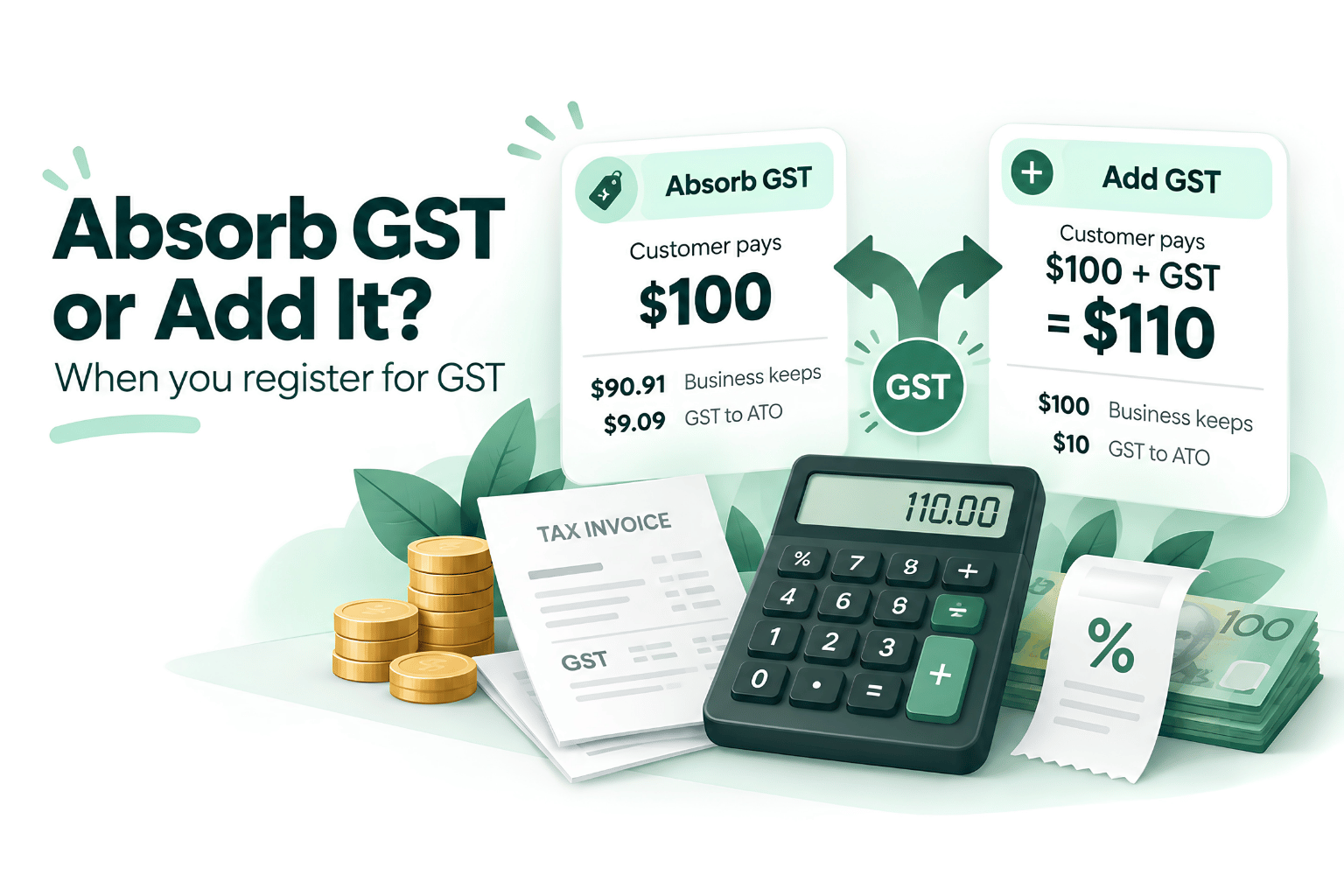
If you are deciding whether to pass on all of the GST or keep the customer price unchanged, read Should I Absorb GST or Add It to My Prices?
How do you remove GST after it has been added?
Removing GST is not the reverse of adding 10%.
If a price is already GST-inclusive, don't simply subtract 10%.
Example GST-inclusive amount:
$110
Why divide by 11?
The GST-inclusive price represents 110% of the original price. GST therefore represents 10 parts of that 110-part total, which is one-eleventh.
See How to Remove GST From a Total for the reverse calculation and worked examples.
FAQs
How much GST do I add to $1,000?
If $1,000 is excluding GST:
GST = $1,000 × 0.10 = $100
Total including GST = $1,100
If $1,000 already includes GST, do not add another 10%. The GST already contained in the amount is:
$1,000 ÷ 11 = $90.91, rounded to the nearest cent.
What is the difference between GST-inclusive and GST-exclusive?
A GST-exclusive amount is the price before GST has been added.
A GST-inclusive amount contains the GST.
Example:
$200 excluding GST
+ $20 GST
= $220 including GST
Knowing which type of figure you are starting with is essential before using a GST formula.
The bottom line
For a standard taxable sale where your starting price is excluding GST:
Example:
Before applying the formula, make sure the starting amount does not already contain GST and that GST applies to the sale.
Sources & References
Related Calculators
Related Guides
Should I Absorb GST or Add It to My Prices?
Compare passing on GST, absorbing it or sharing the increase.
How to Remove GST From a Total
Use divide-by-1.1 and divide-by-11 formulas for GST-inclusive amounts.
Profit Margin Before or After GST?
Learn which GST-exclusive figures to use when calculating profit margin.
General information only. This article provides general information only. Tax treatment can depend on your individual circumstances.